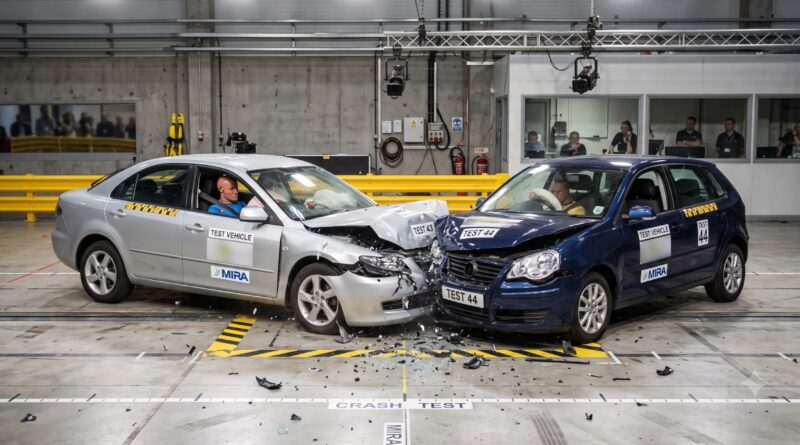
Crash Tests Have Saved Nearly 50,000 Lives in 30 Years
Three decades of independent crash testing have quietly become one of the most effective life-saving programs in automotive history. According to a landmark study released by the Insurance Institute for Highway Safety (IIHS) in June 2026, safety improvements driven by its crash test program prevented an estimated 48,352 deaths on American roads between 1999 and 2024 — while generating an economic benefit to society of roughly $538 billion.
A 30-Year Anniversary Marked by a Dramatic Head-to-Head Test
To celebrate the milestone, the insurer-funded research organization staged a symbolic demonstration: a 1996 Chevrolet Blazer was crashed head-on into a 2026 Blazer in a moderate overlap frontal collision scenario.
The contrast could hardly have been starker. In the 2026 model, the passenger compartment held its shape, and sensor readings from the crash test dummy indicated only a minimal risk of injury — the driver would likely have walked away with little more than scrapes. In the 1996 vehicle, the cabin collapsed inward, forcing the dashboard and steering column onto the dummy. Measurements pointed to severe, potentially fatal injuries to the head, neck, and legs.
It wasn’t the first time the institute has used this kind of demonstration to challenge nostalgia. A previous test pitted a 1959 Chevrolet Bel Air against a 2009 Malibu, dismantling the enduring myth that older cars “built like tanks” were somehow safer.
How Researchers Calculated the Lives Saved
The study focused on the institute’s five core evaluations: the moderate overlap front test, driver-side and passenger-side small overlap front tests, the side impact test, and the roof strength test.
Researchers compared real-world fatality rates between vehicles that earned “Good” ratings and those that scored poorly. They then modeled how many additional deaths would have occurred if the share of highly rated vehicles on the road had never grown.
The findings break down as follows:
- Total lives saved (1999–2024): approximately 48,352
- Frontal crash tests: around 28,697 lives — the largest contributor
- Side impact testing: roughly 18,224 lives
A 900-to-1 Return on Investment
The economic case is just as striking. Using the U.S. Department of Transportation’s “value of a statistical life” methodology, researchers estimated the societal benefit at $538 billion. Over the same period, the entire testing program cost about $600 million to run — a return on investment of nearly 900 times.
Joe Nolan, the institute’s operations director, said it was inspiring to think of the thousands of parents, children, and friends who are alive today because of these engineering improvements.
Why Independent Testing Works
Perhaps the study’s most important takeaway lies in a recurring pattern: whenever a new test was introduced, only a handful of vehicles on the market could pass it. By the time each test was updated years later, nearly every new model was earning top marks.
The lesson is clear — transparent, independent evaluation is one of the most powerful tools for pushing automakers to build safer vehicles. Rather than relying solely on changing driver behavior, making the car itself more forgiving of human error has proven to be a cornerstone of reducing road deaths. It’s the same philosophy behind Europe’s Euro NCAP program and mandatory safety equipment regulations.
Frequently Asked Questions
How many lives have crash tests saved? According to the IIHS study, roughly 48,352 lives were saved between 1999 and 2024 thanks to safety improvements driven by crash test ratings.
When did IIHS crash testing begin? The institute launched its crashworthiness testing program in 1995, marking 30 years of operation in 2025–2026.
Which crash test saved the most lives? Frontal crash tests account for the largest share, credited with preventing about 28,697 deaths, followed by side impact tests at around 18,224.